Info

The Interdisciplinary Work of Lyss Warmland.

Posts tagged feminism

41439796_234680410547565_8702695354878918656_n

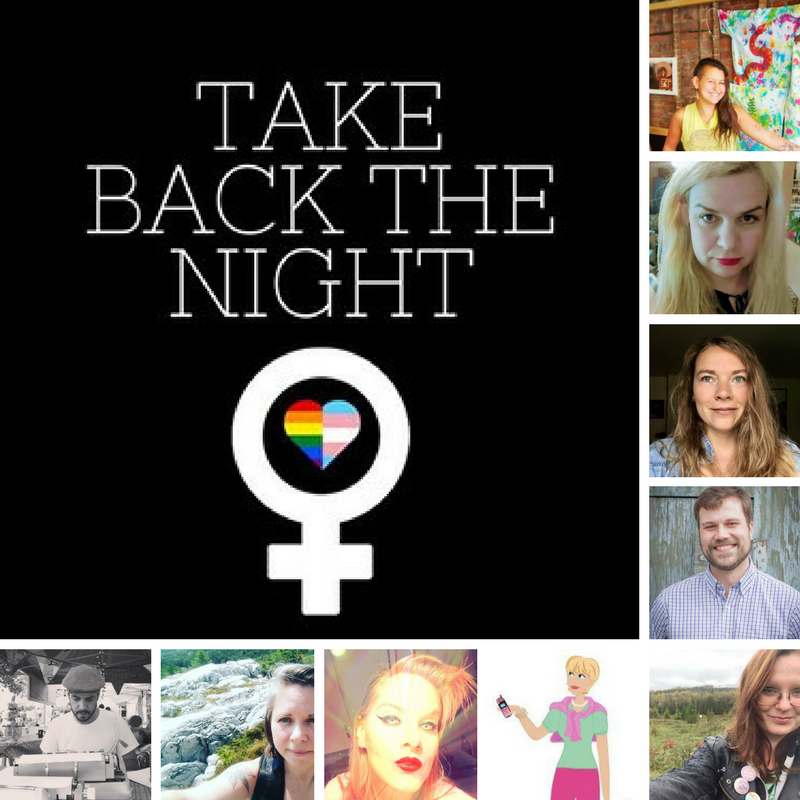
Check out my interview with a handful of members of the Take Back the Night: Port Hope committee: Sarah Kennedy, Ashley Bouman, Ariel Reilly, and Meghan Sheffield. We chat about:
– The details of TBTN:PH
– How TBTN:PH started (and why)
– Our personal experiences with sex education and learning about consent
– The performers of TBTN:PH
– The sponsors of TBTN:PH

Featured Tunes:
Burn the Rapists, Not the Witches by Backyard Riot
Angela by The Hannigan Sisters****
Natural Born Woman by Kim Doolittle****
Don’t Wanna Know by Deviants and the Odd Man Out****

****Performers at TBTN:PH 2018

August 17 LIVE on Northumberland 89.7 FM Small Town Radio!
LISTEN HERE for the podcast version. 

9FEF48B2-E523-48D8-846A-AAC51D11DC71

Check out my interview with the surreal Jeannette Breward!
We’re gonna talk about:
– incorporating environmentalism and feminism into her work
– Using her body in her work intentionally
– The influence of surrealism on her work
– the inspiration for her surrealist still photographs
– Jeannette’s creative process
– Jeannette’s favourite things about Northumberland County
– All about her film “60 Seasons”
– How creating keeps her well
– What you can expect next from Jeannette- INCLUDING a super cool collaborative film project she and I are working on together! Listen to us brainstorm and discuss what we’ve been thinking about regarding this project. Basically, WITNESS OUR PROCESS!

Featured Music

Suddenly by Sweet Alibi
Into the Dark by Good Lovelies
Mary by Kate Boothman
Birthday Cake by My Son the Hurricane

Listen to the Podcast HERE!

IMG_5560

Leisse Wilcox is a mindset coach and writer from a tiny beachfront town east of Toronto. A mom of three little girls, her passion is working with women to help them dig deep, get clear and confident with who they really are, and help them find, express, and use their voice for good, in a lifestyle-friendly way. Using her uniquely grounded and peacefully honest perspective, she has spoken, been published, and consulted internationally on subjects ranging from self-love, parenting, healing old wounds and creating new behaviour patterns, and social media brand strategy and authenticity.

When not engaged with clients or kids, Leisse can be found stargazing, dreaming about an A-frame cabin in the woods, or anywhere the tacos are.”

We talk all about Leisse’s work. One thing we talk about a lot is, as Leisse puts it, “the paradox of positivity”.

Featuring:

“Positivity Does Not Mean You Get to Tune Out Your Shit” By Leisse Wilcox
“How to Escape and Prevent Toxic Communities” By Lyss England

Featured Tunes:

Lovin’ You Baby by Charles Bradley & The Menahan Street Band
11:11 By Arkells
Good Lover by Donovan Woods
Make It Happen by John Splithoff

aka. “Acknowledging autonomy as a means of building healthier communities”
22448311_1937659436556969_852786124772339943_n.jpg

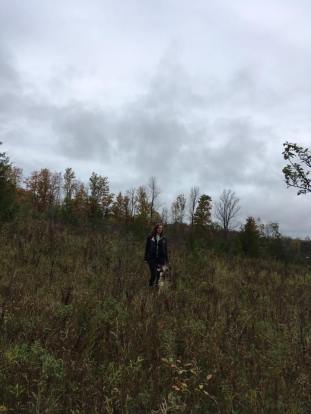
(image shows myself and my best friend, Luna the shepherd dog, in an open field surrounded by trees, representing simultaneous autonomy and interconnection).

Can you think of a time in your life where you wanted to be part of a community of people who you grew close with, even loved? Where you put a lot of time and energy into creating that community with some sort of shared goal or intention? Me too.

I’ve been a part of theatre communities where we worked on shows together, activist communities where the shared goal is dismantling rape culture or working towards environmental sustainability, and casual communities where the goal is simply to be friends. Sometimes this more casual community building looks like a group who gets together to share meals or to work together in a garden. Sometimes, like many people in my generation, this means online group chats.

Can you think of a time where you felt let down by your community? Maybe you were going through something really tough and craved the support of the community you’ve worked hard to build. Maybe you felt ignored or under appreciated. I can relate. It’s really easy when we feel this way in our communities to chalk it up to “toxic communities” and honestly, that’s the script that is growing to dominate a lot of modern thought around social justice. But I think that this is an oversimplification at best, and, more honestly, actively detrimental to the overall goal of community care and individual wellness that social justice aims to work towards.

Community building as a concept is complicated and I see a lot of discussion around some of the key pieces these days. Things like self-care, balancing emotional labour, and accountability. While it’s exciting that these discussions are happening at all, and it’s to be expected that thinkers will stumble their ways through these complex and imperfect topics, I, a white, queer, disabled woman who lives with CPTSD, am increasingly finding that the shallow way we discuss this stuff is more harmful than helpful.

Basically, what I’m asserting here is that the problem isn’t that we are building toxic communities, it’s that we are empowering individuals to engage in behaviours that are toxic to themselves, and thus, toxic when it comes to building healthier communities. We mistake enabling self-harming behaviours for care in attempt to acknowledge that the violence perpetrated against marginalized people is real and unfair. However, by encouraging a victim mindset, we effectively marginalize people who have been affected by systemic violence even further.

I don’t believe that it is my job (or my business) to dictate how anyone else chooses to cope with or react to their experiences in the world. I believe that is up to each individual, and that building healthier communities relies on each individual to do their own work. It’s easier, when we have experienced trauma and/or violence to follow scripts where we validate one another’s pain (effectively playing in to the same power dynamics we claim to be working to dismantle) rather than addressing and taking ownership for our own experiences and subsequent (re)actions.

What it comes down to for me, as an individual, is this: do I want to commit to my trauma and live in it, or do I want to live my best life where I acknowledge my trauma without allowing it to control my life?

In the context of a society where there are unequal distributions of power, I would agree that it’s true that one cannot fully control what happens to them or every event of their lives, but what one can control is how they choose to respond to what happens. When it comes to community building, when we are all so committed to living in our own emotional shit, we tend to project that on to other people in our community.

For me, my dissatisfaction in communities I’ve experienced as toxic has a lot less to do with anyone else’s actions but my own dissatisfaction with myself. This results in me being so wrapped up in how worthless I feel (because trauma stuff) and feeling so bad about how I’m not feeling cared for by my community that I’m not being a good community member either. I’m not actually taking care of myself in a deep way either. I’m just wallowing in my own shit. Living there. Committing to it. It’s a lot easier to chalk my feelings up to other peoples’ actions rather than taking ownership for my own and doing something to actively work with whatever it is I’m going through. It keeps me trapped in my own shit.

Escaping and preventing toxic communities comes down to changing our perspectives from “they did this to me and this feels awful” to “this happened and it feels awful because I’m perceiving it as something that was done TO me that I have no control over.”. The reality is that you do have control over what you do with your hurt. Sure, communicating to the person you felt hurt by may be helpful, but what will be really helpful is you changing your perception (and thus, your reality) of the hurtful thing. It’s not about ignoring the hurt or “choosing not to feel it”. I mean, that sounds nice, but we all know it’s not that simple. It’s about feeling it and acknowledging that it probably had nothing to do with you and everything to do with the other person/people. What is yours is your reaction. When we accept people for where they are at, it makes for far healthier and happier interpersonal relationships. And when we can’t reconcile where someone’s at with the reality we’re choosing to actively build for ourselves, we get to choose the context in which you relate to that person.

This isn’t to say that we should stick around people who contribute to us feeling bad or who we don’t ultimately feel are conducive to our journey in wellness. It’s also not about anyone being “at fault”. It’s never so simple as a simple perpetrator/victim dynamic. We are all hurt beings in some way, we are all trying to stumble our way to happiness and fulfillment. But what I think we, as social justice oriented thinkers and carers, would benefit from is actually acknowledging the role of autonomy in community building.

(Big thanks to Sabrina Scott and Susan Kesper for taking the time to provide feedback on this piece and supporting me in making it better!)



June 1 LIVE on Northumberland 89.7 FM Small Town Radio!

LISTEN HERE if you missed it!

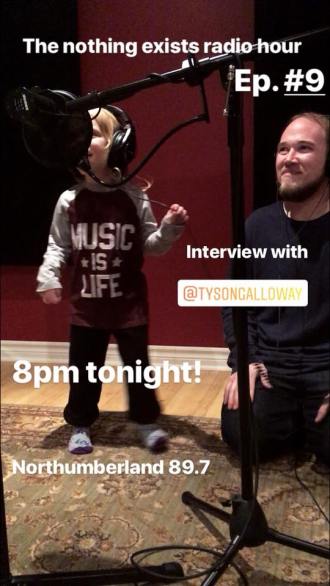
Check out my interview with the wonderful Tyson Galloway !

We’re gonna chat about balancing priorities (like being a professional musician AND a dad AND a husband AND a music teacher), making music as a means of being well, teaching music, and being a man who is invested in learning about feminism.

34090638_120273168787809_3326263239435616256_n

Born and raised in Cobourg, Tyson is a freelance musician, currently instructing at Long and McQuade. He is experienced in a variety of forms of music from jazz to country. On the side, he’s a husband and father, as well as a nature and history buff. Tyson can be seen, locally, with acts like Washboard Hank and Madman’s Window.

Featured Music

Sugar by Ellen Torrie

KR-12032018-ellen-torrie1_large

Maxwell Murder by Rancid

download

Autumn Leaves by Tyson, Julian, and Clayton

17191311_841417019340775_3283626072687083202_n.jpg

May 25 LIVE on Northumberland 89.7 FM Small Town Radio

LISTEN HERE if you missed it live!

Check out my interview with a woman who may as well be my twin (seriously! we were born 2 days apart!). She’s got a lot of good things to say, def worth the listen.

33422688_118908232257636_3066144626827067392_n

Cailey McCormack is a young professional with a heart of gold from Port Hope. She is a lover of the outdoors, dogs, and wellness all while building a successful career. She’s passionate about social justice, and has a unique and compassionate approach to her activism, operating from the perspective that people come from good intentions and that it’s useful to meet them where they’re at. She says, “when creating positive change in any kind of community you can’t underestimate the power of effective and compassionate communication”.

Cailey is also a valuable thinker and world-builder when it comes to the concept of minimalism, connecting it to overall health and wellness in an accessible, practical way.

Cailey is a fixture at Turtle John’s Friday night karaoke in Port Hope, ranging in song choice from Sublime to Johnny Cash. When she’s not making change in her community, you can often find Cailey hanging out with her one year old dachshund, Reese, at her family’s cabin in the woods.


Featured Music:


April 27 LIVE @8pm on Northumberland 89.7: Truly local radio:
LISTEN HERE if you missed it live!

cropped-notih5c5c.png

Join Lyss and guest, Jeff Caine, to discuss topics including:
– The Stars of Port Hope Civic Awards
– An update on Green Wood Coalition
– The recent sexist terrorist attack in Toronto and “incels”
– Redefining masculinity/what men can do about this
– Jeff’s career in the finance world
– Community theatre (specifically, on-stage kissing, among other things)
– Jeff’s radio show

Image may contain: 1 person, smiling, text
“Jeff Caine is a die-hard, newly award-winning Port Hope resident. Radio personality, finance dude, and semi-professional Good Guy, you can listen to Jeff on Northumberland 89.7 on his show “Northumberland Focus”, Mondays at noon. Jeff has a long history of involvement with the radio station, has sat on the Green Wood Coalition board for several years, is involved in community theatre with the Northumberland Players, sits on committees with the Municipality of Port Hope, and sits on the Take Back the Night Port Hope committee.

A news fanatic and closet wrestling fan, Jeff is passionate about his community, his friends, and not being a complete and total jerk.”

Featured Tunes:

“Angela” (Lumineers cover) by The Hannigan Sisters (of Clan Hannigan)
eileayisha.jpg

I heard The Hannigan Sisters (Eile and Ayisha) play tonight at The Stars of Port Hope Civic Awards and they sounded gorgeous. So gorgeous, in fact, I made a video of the second song they sang and came home to convert it to an MP3 so you can all hear just how gorgeous that 3.5 minutes was.
These teens also play with their family’s band, Clan Hannigan, which also includes their very talented mum, Saskia Tomkins.

“I’m Done” by Bad Cop / Bad Cop

Image result for bad cop bad cop

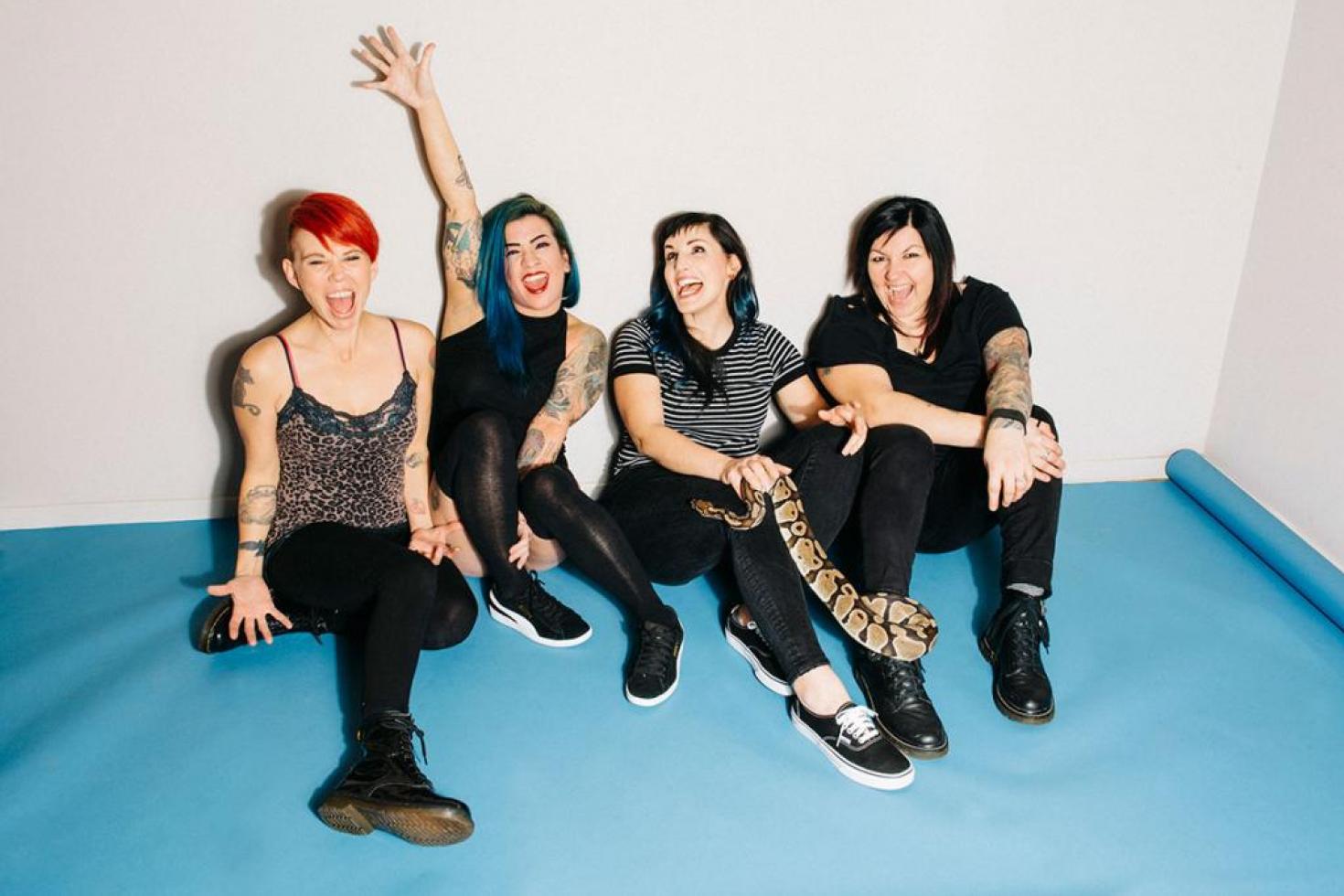
Based out of LA, this feminist punk band is signed to Fat Wreck Chords and released their most recent album, “Warriors”, in June of 2017.
The story behind their new album is especially powerful. After the release of their first album, “Not Sorry”, Bad Cop/Bad Cop toured often and one of their singers, Stacey Dee, began partying too hard. It began to affect the band, but with the support of her bandmates and her label, Stacey was able to receive treatment and work towards wellness.
“Warriors” is the product of Stacey reuniting with her bandmates to create something new after a significantly challenging experience.
“We tend to stick up for the underdog,” Dee concludes. “It hurts us when anyone is marginalized. I was so negative for most of my life. After changing my life, I have been trying to focus on strength, connectedness and positivity. I think this record is a good start.”


“Chick Singer” by Winona Wilde

Image may contain: 2 people, people smiling, closeup


“A child of Iraqi parents, [Winona Wilde] was born Noosa Al-Sarraj and became infatuated with playing classical music on piano at a young age. At the same time, her country music-loving nanny planted the seeds for her future devotion to artists like John Prine, Hank Williams and Loretta Lynn, and by her teens she discovered a natural ability to write songs in a similar style.

Noosa explains, ‘On my first album, I was too afraid to be good. On my second album, I was too afraid to be real. This time I feel like I am as real as I can possibly be, and the songwriting is infinitely more vulnerable.’”

The woman who describes her music as “Canadian Feminist Folk” mostly calls Peterborough home and can be found playing just about all over the place. Winona Wilde‘s newest album “Wasted Time” just came out this past October 6. Lurk her facebook pagewebsitespotify, or bandcamp for all things Winona Wilde.

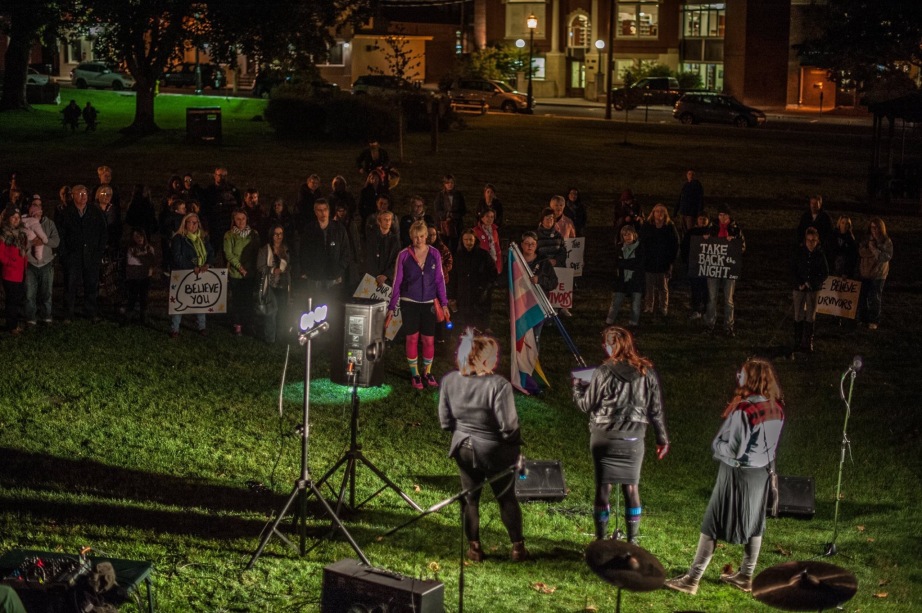
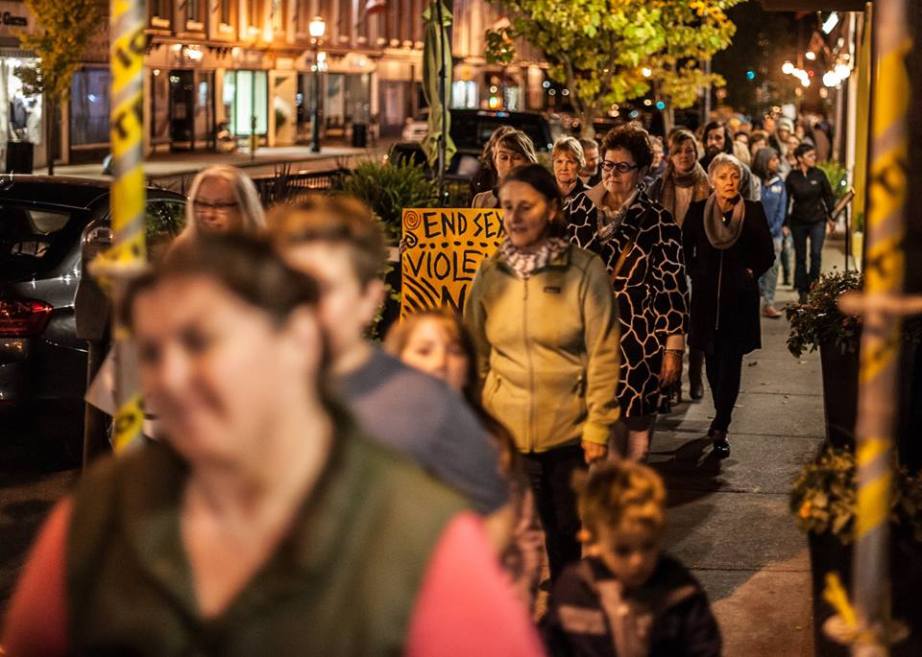
tbtncrowd
Photo by Walton St. Photography.

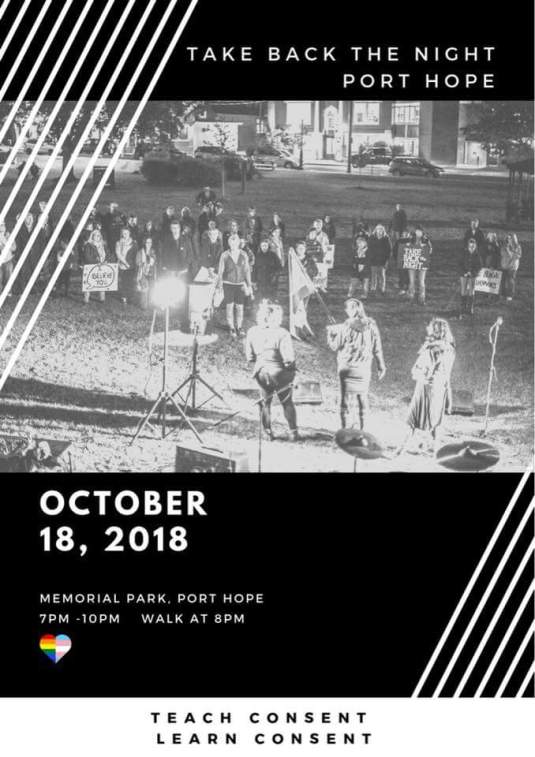
Mission: Take Back the Night is a community based event to protest the fear that women and trans people have walking the streets at night safely. Take Back the Night is also a grassroots event that honours the experiences of survivors of sexual violence, sexual assault, childhood sexual abuse, domestic violence, and survivors of state violence such as police brutality, racism, ableism, sexism, and other forms of institutionalized violence. The goal of the event is to offer Northumberland County residents an opportunity to stand together in solidarity against institutionalized violence and oppression as a community. The event is free to attend.

When: Thursday, October 19 at 7PM
Where: Memorial Park, Port Hope (the traditional territory of the Haudenosaunee, Anishinaabe, and Wendat peoples)

People of all genders are welcome at this event, which centres the women and femmes who disproportionately experience gender-based and sexual violence. Men, we invite you to walk in solidarity with us.

Peer support will be available if you find yourself in need.

There is an after-dark walk component to our event, so you may wish to bring along a flashlight or be sure to have your cellphone charged to use the flashlight app. Choose your footwear accordingly.

Our itinerary:
Meet at 7PM at Port Hope’s Memorial Park to gather, get direction, and hear a few songs and stories.

Then we walk together, on a short, accessible route through Port Hope’s downtown, through a quieter, more dimly lit stretch along Lent’s Lane and back to the park via Dorset and Queen Streets.

We’ll close out with a few more performances back in the park, and then all are welcome to join us for a low-key debrief with snacks and music at Green Wood Coalition’s space on Ontario Street.

thewalk
Photo by Walton St. Photography.

Theme: “We are Not Unfounded

Earlier this year, the The Globe and Mail released an investigative report into police rates of designating sexual assault reports “unfounded,” meaning officers don’t believe a sexual assault took place. Across Canada, the rate is nearly 20%. In Port Hope, between 2010 and 2015, 45% of reports of sexual assault were labelled unfounded.
Because we believe survivors, Port Hope’s 2017 Take Back the Night event will have the theme “We are not unfounded.” Join us on Thursday, Oct 19 at 7PM.


Press Releases:
Press Release in Northumberland News here.
Press Release in Port Hope Now here.

Official Photos From Event: 
Official photo album by Walton St. Photography here.

Articles About the Event:
“A Cobourg woman speaks out on workplace sexual harassment that left her terrified” here.
“Port Hope’s Take Back the Night walk resonates in an era of #MeToo” here.

Contributing Artists:
Read Jenni Burke’s blog post about Take Back the Night here.
Read Cassie Jeans’ poem “For my Sacred Sisters who are Healing from Shame” here.
Listen to/watch Winona Wilde play her song “Chick Singer” here.

Sponsors:

Racine Financial
Long and McQuade
Emulate Global Printing and Finishing
Green Wood Coalition
Walton St. Photography
Port Hope Public Library
Royal Ribbons

22519284_123151048367169_6894603066436190662_n

Display to promote the event at Port Hope Public Library. Photo by Gareth Vieira.

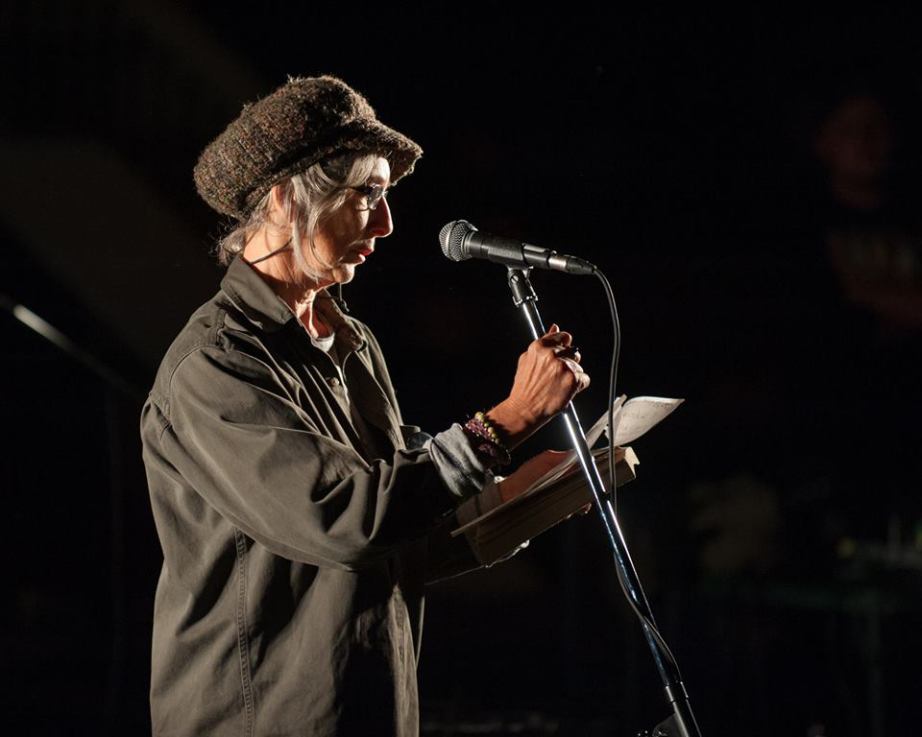
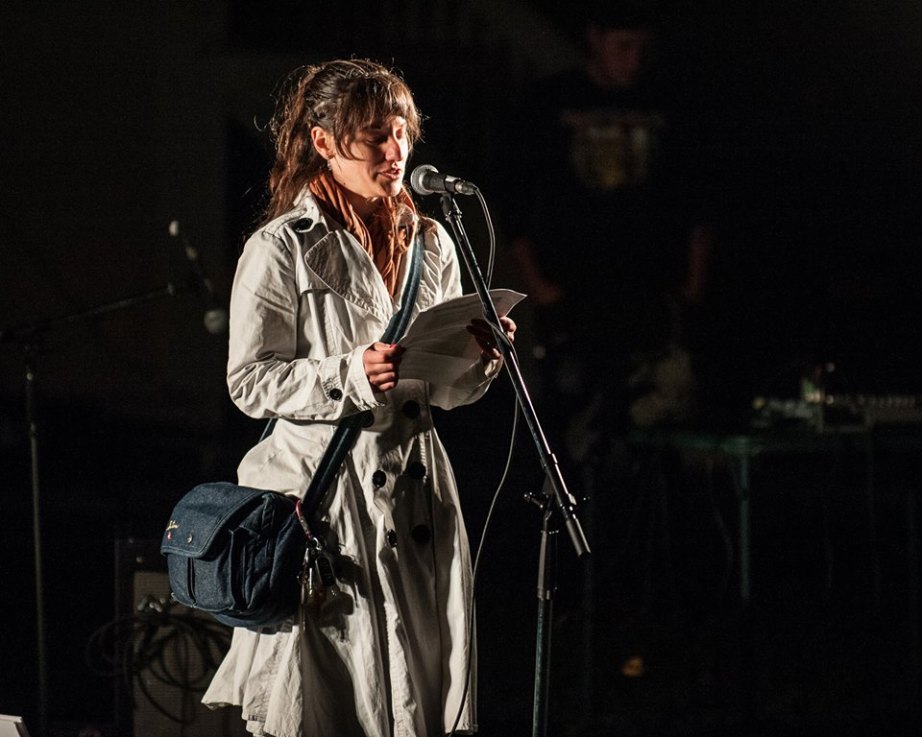
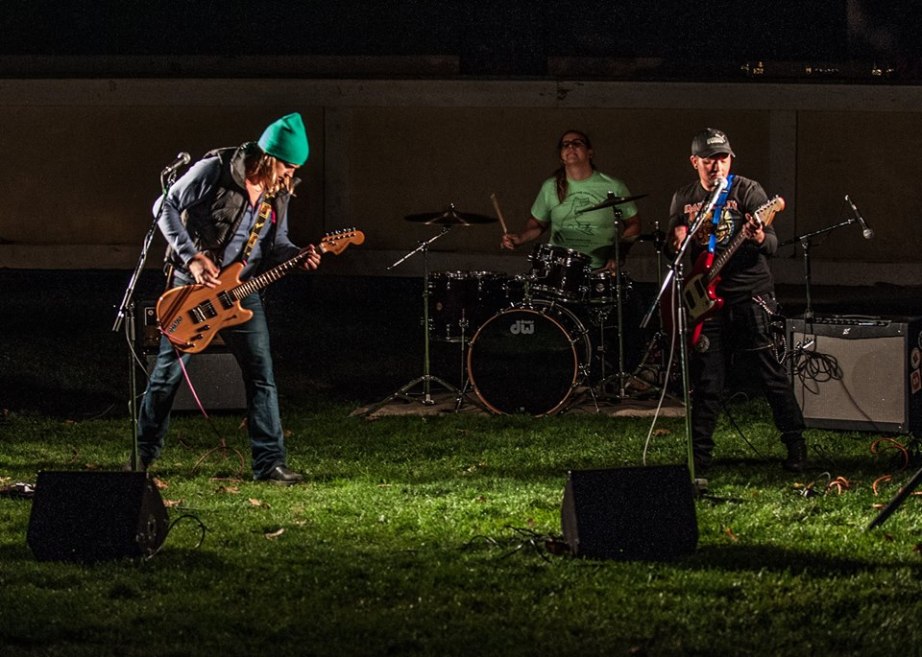
Performers:

eileayisha.jpgEilé and Ayisha Hannigan

jane.jpg
Jane Storie

natalie
Natalie Galloway


brooke.jpg
Brooke Sterzenegger

kim
Kim Doolittle

devients
Deviants and The Odd Man Out

hailiah
Hailiah

TBTN Planning Committee:
tbtncommittee

“We’re a diverse collective, and together we share a common interest in making Port Hope a safer and more supportive community for all of us.”

Gareth Vieira
Jenni Burke
Ashley Bouman
Avril Ging Ewing
Lyss England
Jeff Caine
Meghan Sheffield
Ariel Reilly
Marcela Calderon Donefer

Okay, I don’t really know what the revolution will look like. To me, it’s already happening. It looks like: community gardens/ community meetings/ learning to take care of ourselves (whatever that means)/ community dinners/ debriefs/ sober spaces/ systemic institutions that are honestly willing to accept feedback/ spaces that aren’t sober/ art groups/engaging in discussion about what caring for one another looks like. The reason those things feel revolutionary to me is the focus on simultaneously taking care of myself and also actively caring for the people (and other non-human beings) in my life. 
 
Standpoint theory is a postmodern feminist assertion that day to day experience is what shapes a person’s knowledge of the world, which informs the way they experience the world and shapes their identity. Scholars such as Sandra Harding, Nancy Heartsick, Patricia Hill Collins, and Dorothy Smith have written about it, and a lot of modern-day feminism is approached according to it. You and I went to a theatre to see a play and I sat front and centre and you sat on the back, stage right. After the play, we sit down for coffee and discuss. You saw things that I didn’t see and I noticed things you didn’t notice because we had different perspectives of the performance. Similarly, if you are a straight, masculine person of colour, you are going to experience things differently than I, a queer, femme, white person. Intersectionality is the concept that identity is comprised of multiple standpoints, all of which work together to inform the experiences and identity of a person. Identity informs experience because the world we live in is one comprised of thousands of years worth of historically informed power dynamics which are embedded in defining concepts that construct social and legal systems. Comprehending identity according to standpoint theory and intersectionality can be difficult, because once you think about yourself in relation to these concepts, you’re faced with the realty that you’re privileged in some ways, and likely being systemically oppressed (oppression = systemic power + prejudice) in some ways as well. This is a complex reality to be faced with. But when you start to explore it, beautiful things happen.
 
Finding your “authentic self” is, simply, a never ending process. It’s a process full of checking in with yourself about what qualities and subject positions make up your identity, and how you perform your identity in relation to the social world. To me, finding for my authentic self means analyzing my subject positions, and it also means being honest about my capacity to actively care for both myself and others. As with many things, it comes down to balance. Being honest with myself about my capacity. This requires me to make myself vulnerable enough to be authentic with myself. It’s been a far from linear journey towards recognizing my capacity in this sense. I am a person who gives until I am depleted. This may sound like a positive quality, and in some ways, it is. But in other ways, it’s rooted in selfishness. I get off on caring or other people. Call it mommy issues, call it a saviour complex, either way, caring for others makes me feel good. But this can be problematic in that not only does it deplete myself, but it leads me to inserting myself into peoples’ lives because I identify them as needing to be cared for. 
 
This is where the concept of capacity comes in. When I get that urge to care, I ask myself: What is my capacity to engage in the situation? Sometimes, the answer is that I am feeling relatively emotionally well, relatively physically well, and I have the time to allow to providing care for someone. Sometimes, I am struggling with pain or mental health shit that lessens my capacity. Sometimes, I don’t have time. Sometimes, I weigh the amount of emotional labour the other person has contributed outward when they had the capacity and the balance is off for me. 
 
The next question I ask myself is: why do I feel that someone may benefit from my emotional labour? Sometimes, the answer is that I have skills or knowledge that may be useful. Sometimes, it’s that the person has explicitly asked for support, advice, counselling, or another form of active caring. Sometimes, the answer is that I feel compelled to do something that I think may make someone else’s life easier or happier, whether they agree or not. 
 
As always, consent is key when caring, and it’s a much more complicated concept than someone asking for emotional labour or not. Ideally, we would live in a society where consent is always given verbally and explicitly. “I need support/advice/help/validation, is it within your capacity too engage in this kind of emotional labour”. I actually have groups of friends where we do this and people will actually reflect and acknowledge whether or not they have the capacity to engage, and in what way. I feel that moving towards this kind of mutual, consensual exchange of emotional labour is absolutely revolutionary. Of course, there are situations where people (ie. me) assume predetermined consent, or where people are physically and emotionally unable to take care of themselves in a way that puts themselves or others in danger. This is where this concept gets really complicated, and I can’t even begin to think of answers. But this is where discussions come into play. The almighty exchange of knowledge based in lived experience.
 
So, now you’re thinking about authenticity, capacity, and emotional labour, but what next? I think that with this process, there eventually comes a sense of assertiveness. I understand my Self, my capacity, my needs, and I am comfortable asking for them and receiving them. There also comes a time and place where you find a sense of “okayness”. I am okay with my Self and what is happening in this moment because I am in it, and it will pass one way or another in a way that will contribute to my process and my experience of the world. Sometimes this is simple, other times, it may challenge the very essence of your sense of Self, and it feels like you’re back where you began. This concept of “okayness” is often referring to as “radical acceptance”.
 
How are these concepts revolutionary? By actively caring for both your Self and the people around you, it alters the workings of our social world. First on a personal level, and then an interpersonal one. It shifts focus from productivity, to an ethic of care, which is arguably far more complicated, but also more sustainable. This shift toward an ethic of care then expands:
 
Self -> interpersonal ->  social systems -> physical environment.
 
When we learn to prioritize an ethic of care in accordance to the capacity of each of our authentic selves, that is absolutely revolutionary.