
After I’ve opened myself
A thousand times
-More than that
Uncountable times
Exposed the insides
That I wear so outwardly
You would think that
Maybe
I would find some way
To feel held
By the fractured ice,
By salt stains, bright lights
But as it turns out,
It is me
My plain language
My “could be pretty” face
My still-too-big body
Where I sit with my
Self-loathing
Where I turn it into
Care and compassion and the
Tight embrace
I have searched through
Winter for
For eleven years.
Posts tagged mental health
Choose another tag?
One survivor’s take on discussions about gender-based violence becoming mainstream:
CW: rape, sexual violence, gender-based violence, restorative justice, hollywood, violence against women, masculinity, emotional labour, men’s mental health, #MeToo campaign, gender
Nearly a decade ago, I read a book called “Cunt: A Declaration of Independence” by Inga Muscio and it kind of changed my life. It’s a book that’s far from perfect, but it was perfect for me to read at the time. I had been sexually assaulted and slut-shamed a few months prior, and was coping by self-harming, writing songs I’d never show anyone, and listening to a ton of Bikini Kill in my bedroom. Although I was always told I was an emotional being, not a logical one by most people when I was growing up, I know now, looking back, that I’ve always been a very logical and analytic person. I wanted to understand what had happened to me, and I desperately wanted to be well. “Cunt” was just what I needed to begin to feel knowledgable about the dynamics behind why gender-based violence happens and empowered regarding what comes next.
So I did a lot more reading, went to university for Women’s Studies, focused my work on sexual violence prevention, and produced 6 plays about the stories of sexual violence survivors (directed 2 of them). Then I moved to a rural community where I situated myself firmly on the ground of anti-rape advocacy. This whole time, I was in and out of therapy, I was writing, I was learning to form positive relationships, and I was working hard on my own (continuous) healing process. For the better part of ten years, my life has largely revolved around gender-based violence. Why it happens, what to do about it, how to live through it. It’s complicated and layered and non-linear.
During my first week of university, in 2009, when I really started to dedicate myself to this subject, I remember introducing myself to people who asked what my major was only to have them scoff at me and tell me we don’t need to study gender and that I’d never go anywhere with that degree. During my final semester, in 2013, I remember trying to write a major research paper about the representation of non-binary gender and having a difficult time finding academic resources on the subject- to the point where I used blog posts and tweets as sources for my academic paper.
Four years later, that paper is now so outdated that you couldn’t pay me enough to let you read it. But at that time, it was pretty cutting edge and I was really proud of it. That much changed in only four years.
Over the time since I first read “Cunt”, there has been a MASSIVE shift regarding the topics of gender and, more specifically, gender-based violence. Especially recently, with the viral social media #MeToo movement and the trend in Hollywood where serial abusers are being called on their behaviour by the women they have assaulted, discussion around gender and gender-based violence is becoming mainstream. And I get it: it’s a lot to ask someone to radically reconsider who they are and the way they exist in the world, which is what happens when you ask people to critically reflect on the ways gender rolls are constructed. But at the end of the day, I would like to believe that most people don’t want nearly every woman in their life to have experienced gender-based violence in some form, as evidenced by the massive success of the #MeToo movement. And I want to believe that anyone is capable of doing better.
I also want to take just a moment, before I continue, to be extremely clear that I am referring to women in this essay because women are disproportionately affected by gender-based violence. And even more disproportionately affected by gender-based violence is women of colour, indigenous women, immigrant women, queer women, women with disabilities, transgender women, and women living in poverty.
I’ve recently had some friends who know how obsessed I am with gender-based violence ask me to comment on the discourse rising in mainstream culture. And my over-all comment is that it’s amazing and important that light is being shed on gender-based violence in mainstream culture. With that being said, that discourse is overwhelmingly immature (which is to be expected!) and I urge people to listen to the survivors who have been speaking out about these topics and symptoms for longer than it’s been cool (even, arguably, safer) to do so.
Regarding discussion in mainstream culture on the topic of gender-based violence, there a few specific subjects I’d like to share my thoughts on. Here they are in a slightly more digestable format:
Yes, people who have been doing the work around these topics should have their voices magnified over the opinions of people who are just starting to think about this. And no, there’s nothing wrong with acknowledging you’re just starting to learn about a subject and listening to the people who have put in extensive time and energy around it.
Hopefully, by this point in the essay you already get my perspective here. But I’ll give you a metaphor to help communicate my point.
I drive a car pretty much every day. I own one, I know a little bit about how it works, I live in a world where there are lots of cars around. But I am far from a car expert. I haven’t really spent that much time thinking about how cars work, or the history of cars. I don’t know statistics about cars off the top of my head, and I haven’t spent years tinkering around under/inside a car, examining parts and trying to figure out what makes them work best (or at all). So when I take my car in the mechanic for maintenance and they tell me that I desperately need a part replaced or my car is gonna be seriously messed up, I’m not gonna go “well, I haven’t noticed anything wrong with my car, my car gets me to and from work every day and it’s fine”. If I have time, I might educate myself on the part of the car that’s apparently damaged, I might call a friend who has spent a lot of time and work learning about cars, I might consult a few other mechanics, but I’m not going to consider my limited knowledge on the subject equal to theirs. I’m going to listen and try to learn more.
To be clear, it’s not a matter of anyone being “better” than anyone else or attaching value judgements to knowledge that people do or don’t have, or recreating power dynamics. It’s about knowing when to share your perspective and when to sit down and listen.
I also want to be clear that the time and space I’m referring to need not include formal education, however, participating in formal education does take a lot of time and space. It’s not a reason either way to invalidate the type(s) of work a person has put in.
Don’t derail conversations about gender-based violence by centring the conversation around men as victims.
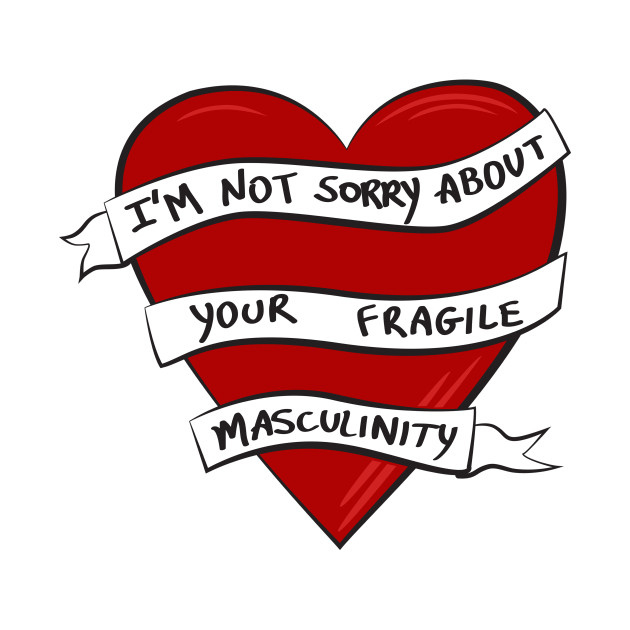
There are many cases where men experience rape and sexual assault. All sexual assault survivors deserve support and space and communities, and I do not, for a moment mean to diminish the importance of men’s mental health. I’d like to be clear that it’s not men who are the problem here. There isn’t even a one-stop answer regarding what the problem is. But a major part of it is the way that masculinity has been defined and then systemically privileged . A key component of the definition of masculinity is being more logical than emotional and being emotionally strong. This doesn’t leave much space for men to cope with their every-day feelings, mental illness, or trauma. As a result, there are many men who struggle because of this definition, as well as women and femmes who are, by negative definition, left to bare the brunt of the emotional labour.
Constructions of gender are not innate, they are something we can actively work to redefine- if you’re willing to do the work.
Although all gender-based violence statistics should be taken with a grain of salt, over 80% of sexual assault victims are women and something like 99% of rapes (against people of all genders) are perpetrated by men. When you derail conversations about gender-based violence to redirect the conversation to focus on men who are sexual assault survivors, you’re taking up a disproportionate amount of space.
Instead, I would encourage people to actively dismantle gender roles and to make appropriate space for men who have been victims of sexual assault to talk about it and heal. This isn’t going to happen through derailing women’s social media posts about gender-based violence.
Don’t derail conversations about gender-based violence to make disproportionate and inappropriate space for conversations about false allegations.
If you think being a man is scary right now because you’re worried about false allegations, maybe you should consider how scary it has been to be a woman or femme throughout history. Only between 2-4% of rape allegations are falsely made.
A study a few years ago found that 1/3 college men would rape a woman if they knew they could get away with it. According to a far larger study done by the UN, most men actually don’t believe that they are raping women.
What this shows is that a lot of the “false allegations” are made when a man didn’t understand that what he was doing wasn’t consensual. Again, this is related to the construction of masculinity- and not just that- the construction of femininity as the negative definer of masculinity. This is why learning about consent is REALLY important.
Exclusion isn’t restorative justice and it will usually result in more problems than it prevents.
There are cases where people are part of a community and they harm people in that community over and over again. There’s a clear pattern, and then when confronted with being called in (not out), they repeatedly get defensive, aggressive, and refuse to listen and (un)learn. In that case, I think it’s perfectly acceptable to ask someone not to be part of a space/venue/show/event/whatever. There are also situations where a survivor may not feel safe being around someone who has harmed them, and that’s valid and well worth working to navigate, based on the specifics of the situation.
There’s this thing that often happens now in popular culture (and in communities) where someone is exposed for something problematic they’ve done and then everyone either jumps on the “I’m so edgy” bandwagon (spoiler: condoning people hurting other people isn’t edgy, it’s just shitty) or boycotts their existence. The person accused of perpetrating harm immediately gets banned from community spaces, blacklisted from work opportunities, and abandoned by a good portion of their support system.
I get why this happens. It’s a reaction that many feel is justified, and I believe in providing space for that. But I also don’t think it’s particularly useful in a larger context. When we position people as inherently a perpetrator or inherently a victim, we do justice to no one. Reducing anyone to such a simple definition simply doesn’t allow for the root issues to be addressed or for working towards a place of healing, learning, or reconciliation.
That being said, restorative justice and accountability are complicated and fuelled concepts that don’t have any definite definition. I recommending reading up about it and talking about it a lot. It’s really complex.
There’s so much more to say, but I’m so tired. I’m excited for these conversations to be on the table in mainstream Canadian culture, not just in women’s studies classrooms or rape crisis centres or teenage girls’ bedroom floors. But there is a lot of work to do, and there will be growing pains. Please. Do the work, listen to survivors, and do better. Because we are all capable of doing better.
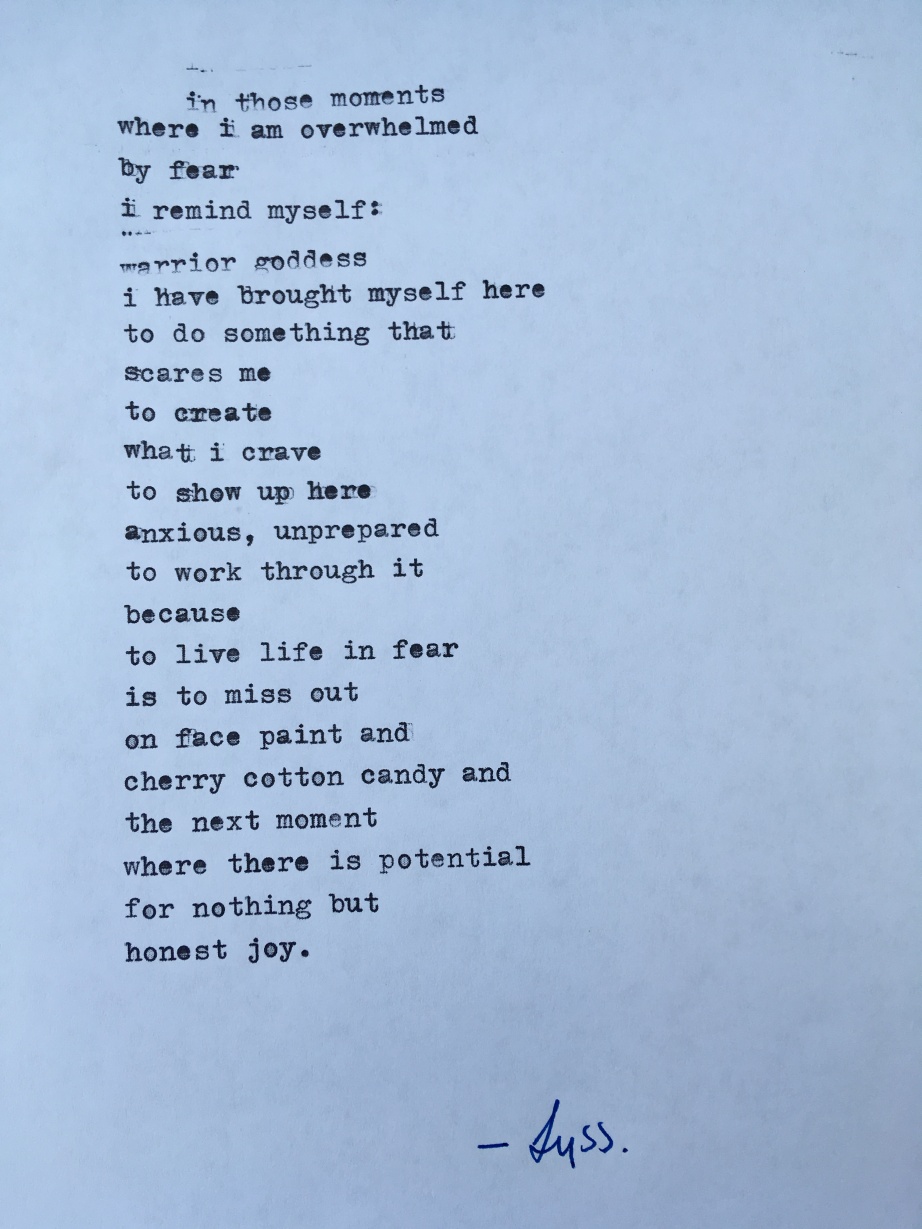
Honest joy
Harvesting Joy

April 2016- The Performance and Disordered Eating Project.
The intention of this project is to promote healing and storytelling through community and performance. There will be an open call to anyone who wishes to get involved in the process of creating a piece of performance art regarding the topic of disordered eating and performance.
There will be efforts made to encourage a wide range of people to participate in the workshopping and performing process. This includes diversity in age, gender, race, sexual orientation, ability level, and type of disability. While, ideally, most of the collective would be comprised of people living with disordered eating behaviours, it may also be interesting to hear from people supporting loved ones living with disordered eating behaviours or people who work closely with performers living with disordered eating behaviours. There is no cost to participants associated with this program.
There will be a five week series of workshops where this group of people will discuss things such as:
How does disordered eating affect performers? How does disordered eating affect performance itself?
What is performance?
What is disordered eating?
How does performance affect people physically and emotionally?
The difference between intentional and unintentional performances regarding disordered eating
Is there a place for people with disordered eating behaviours in spaces that promote performance?
How can we support one another regarding disordered eating behaviours?
while also taking care of ourselves?
How can being creative contribute to healing?
How does body image affect performance?
The lived experiences of performers with disordered eating behaviours?
Any people involved in the workshopping process will be invited to work on the actual writing of the performance based on the notes from the workshopping process. The format of performance will be discussed amongst collective (monologues? One act play? Music? Dance? Movement? Visual art? Combination?) There will be 4 rehearsals and two performances at the end of the workshopping process. Tickets will be sold for $20 each, with compensated and discounted tickets available to anyone who would like to attend, but cannot afford the ticket price. There will also be a “pay what you can” donation jar available at all performances and throughout the workshopping and rehearsal process.
Other topics will likely come up, and anyone involved in the collective will encouraged to bring up topics that are relevant to the project. Notes will be taken at each workshop. Workshops will be co-facilitated by Lyss England and Jillien Hone. Workshops will be done according to To the Root’s community discussion format.


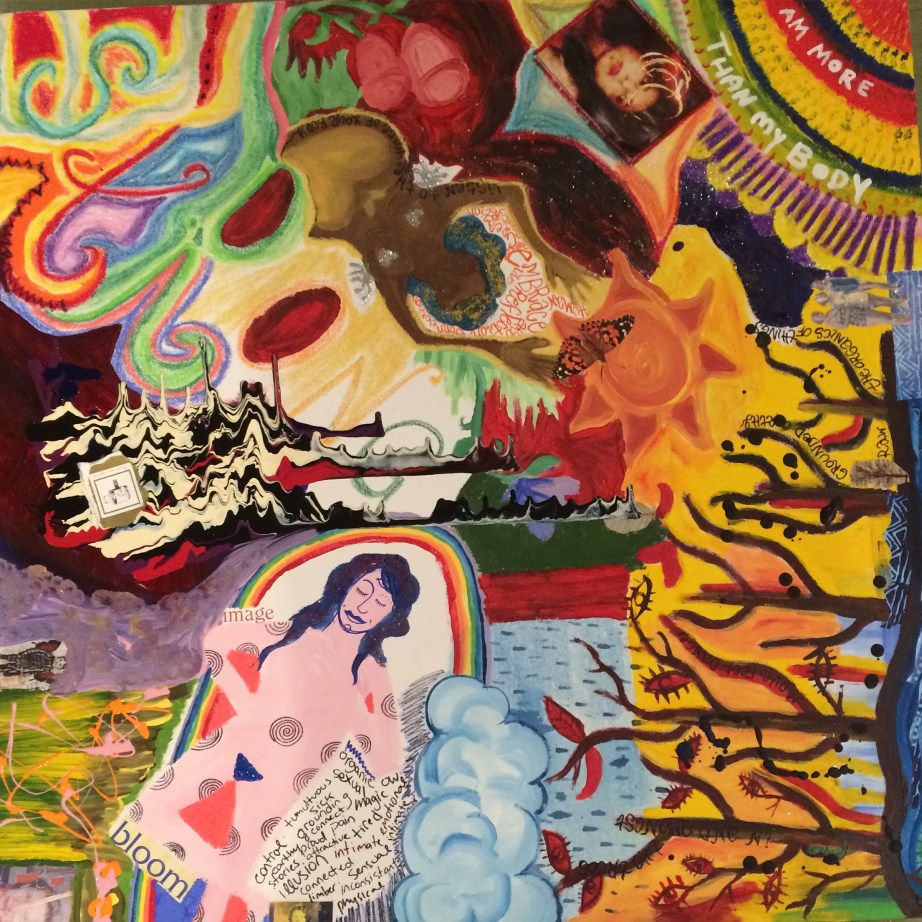 The above is a collaborative piece of art that was produced during the process of The Performance and Disordered Eating Project. The artists involved are Lyss, Jill, Lindsey, MJ, Clayton, and Marcela.

7/21/16// things that feel good today.

I’ve been making lists of things that feel good. There is literally no qualifier for making the list except that the thing felt good. There are no rules, I don’t post these statuses with any real consistency, they just happen when I feel like I need them. I started posting “things that feel good” statuses when I was about six months into a violent (but, as always, functional) depression because I noticed that my thought patterns focused in on negative things that didn’t feel good at all, and that I was focusing all of my energy on those feelings that didn’t feel good. I was looking for a way to train my brain to notice things that felt good instead, and one day I decided to post a list of things that had felt good that day as a Facebook status.The response I got kind of blew my mind. A ton of people liked it or otherwise “reacted” to it. People commented that they thought it was a cool concept. People approached me in the street to tell me they had loved that status.
It was just a status on Facebook, and I hadn’t posted it in hope of receiving any type of response as much as to hold myself publicly accountable for this paradigm shift I was attempting to create for myself. It is an easy way to keep a record. That being said, I’m never one to turn down validation, and the reminders every time I would receive a notification to look at that status were helpful in re-training my brain, because I kept re-reading these things that I was intentionally acknowledging as feeling good. It became a mantra, these Things That Felt Good.
I started posting them more often. As my depression lessened, the posts began to feel more celebratory and less like another thing I put myself through the motions of in hope of feeling better. People continued engaging with the concept of them both on and offline, and even began posting their own. Being mindful of things that feel good was a concept that made sense to a lot of people. And I felt as though it really was contributing to a meaningful change for me.
As a person who is fascinated by performance, I have always felt drawn to public displays of self-discovery and change. I think that expressions of authentic processes of self-discovery are the highest form of art, and that it follows naturally for that art form to bleed into the public sphere. With presentation of this wild display of vulnerability comes the opportunity for those witnessing it to reflect, relate, connect with the artist, and with one another. It creates space for discussion. It also creates space for accountability and the continuation of the process of reflection for the artist.
There’s also something to be said for the intentional self-objectification that comes with using the self as a medium for artistic expression. The process of exposing ones self has been, for me, a way of looking at myself from outside of myself. A way of taking space from my body, and then being very much in my body. Objectifying my Self, and my experiences on my terms. Making my Self a display in a way that I consent to, intentionally.
I didn’t intend for Things That Felt Good Today posts to be an art project when I started to do it, but upon reflection, that is a large component of what it is and what has been healing about it.
Things That Felt Good Today posts are an art form because they are vulnerable displays of mindfulness that is related to the authentic self and are performed publicly. They are full of transformative potential for the artist, and for those who witness them. For those who choose to engage with them, those who create their own, those who think about them.They are a performance piece that feels good.
03/14/17// cement.
I am like one of those
green/mossy/grassy weeds
that grow in between
the cracks of sidewalks.
You see something
undesirable/a mess/alive
and you just want to
pull me out by the root.
What you don’t see is
roots so deep I won’t
ever truly get out from
under your skin-
I mean-
the cement.
05/30/17// night sweats.
there have been
so many nights
where I have sat
awake
watching the sun rise
through swollen eyes
irritated by
the makeup I didn’t take off
the night before
when I fell asleep
feeling sore and
uninspired
unable to write anything
or try to gain confidence
in something I used to be
good at
where I have finally
been able to
sit beside myself
and wait
out
this
loathing
self
it
has
to
pass
minute by minute
I count down
by the clock app
on my cell phone
the friend I most
want to let go
disconnect to connect
even if it turns out
that the only connection
I can trust
is me
sitting beside myself
resenting the sunlight.
 Nothing Exists.